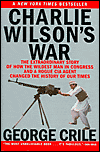
Charlie Wilson's War |
by George Crile
Grove Press |
reviewed by: David Dienstag
for jezail.org
January 1, 2008 |
|
 |
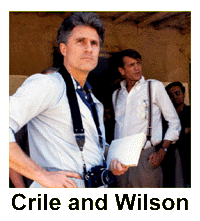  How many times do we have to catch CBS news producers fictionalizing stories before people take a harder look at what they cook up? Charlie Wilson's War is a product of George Crile who was a lead television producer for CBS and covered the Afghan war against the Soviets in the 1980s. His colleagues at CBS, Kurt Lohbeck and Mike Hoover both landed in hot water for fictionalizing or making up stories about Afghanistan that would have been convenient if true but were, in fact, fabricated. More recently, Dan Rather was caught creating a hit piece aimed at George Bush that was based on dubious or phony documents. How many times do we have to catch CBS news producers fictionalizing stories before people take a harder look at what they cook up? Charlie Wilson's War is a product of George Crile who was a lead television producer for CBS and covered the Afghan war against the Soviets in the 1980s. His colleagues at CBS, Kurt Lohbeck and Mike Hoover both landed in hot water for fictionalizing or making up stories about Afghanistan that would have been convenient if true but were, in fact, fabricated. More recently, Dan Rather was caught creating a hit piece aimed at George Bush that was based on dubious or phony documents.
Charlie Wilson's War continues that tradition. Congressman Charlie Wilson (D-Tex.) who, by all accounts, was a drunk, is supposed to have won the war with his theatrical antics. In fact, there were far more serious people involved who are slandered or overlooked in the book, and the Afghans themselves become background noise for the camera-loving congressman and his CIA handler, Gust Avrakotos, aka "Dr. Dirty". What the careening congressman actually did was to ride on the backs of a lot of dedicated and courageous people and get his face in front of a camera at every opportunity.
Of all of the selfless people who risked and often lost their lives to push the Soviets out of Afghanistan, Mr. Crile has created a Lowell Thomas heroic myth about one of the least heroic characters involved.
The book was only accurate in some details and in that it documents the congressman's excesses. The movie, with Tom Hanks as the profligate congressman, is miscast. Think John Belushi. The movie and the book both miss the significance of the policy debate and conversations that have clear relevance to this day. George Crile never had the intellectual horsepower to understand the damage done by a buffoon in the congress and his CIA manipulator. Crile was too bloated with his own lofty über vision of Afghanistan, rooted in his experience in Vietnam and his hatred for Ronald Reagan. Important aspects of the Afghan policy were seriously flawed and that fact never saw the light of day because of Crile, the congressman and his CIA friends.
As a result, America's ability to project power in any region is limited to expensive, dumb leviathans as policy options. An American president can only choose to press a button that sets loose bloated budgets, armies and aircraft carriers—or not. The result: Rwanda, Darfur, Somalia and, perhaps, Kenya among others. This leaves policy makers with nothing more than hammers for surgery. The only way to deal with this or that Islamic meltdown or five-way civil war is to put all of American prestige on the line or stay out. Charlie Wilson's main contribution to history was to single-handedly kill the notion of unconventional warfare, as John F. Kennedy had intended, for the Special Forces to carry out. Instead, American power projection was distorted into an international arms shopping expedition conducted by a semi-rogue CIA agent and a drunken, careening jerk.
The book steers clear of these important facts because Crile and Avrakotos had a symbiotic relationship from the start. It was Avrakotos who pulled the levers in Pakistan to get Crile's boss, Dan Rather, into Afghanistan for Rather's, now famous, cameo in Afghanistan. The two had been colleagues until Avrakotos' untimely death of a stroke in 2005. Basically, Crile has come up with another uncritical puff piece for Avrakotos and the CIA. (He's not the only one in the news business to have done so.) Charlie Wilson's War is merely a continuation of what has become a tradition at CBS and elsewhere in the news biz. However, making "flawed heroes" out of a besotted sex freak and his CIA manipulator should classify this book as fiction rather than history. The inconvenient facts that are left out are, by far, more important.
However, it is a good, entertaining read. A partial truth, it gets some facts right in that it captures the noise and bluster of that period. One wonders if that is really necessary.
|